
Key Takeaways:
- A flashing check engine light almost always means an active engine misfire, not a minor issue.
- Continuing to drive with a blinking light can destroy your catalytic converter within minutes.
- A steady light means “schedule service soon,” while a flashing light means “address it now.”
- Common causes range from cheap spark plugs to expensive compression problems.
- Reducing speed and avoiding hard acceleration limits damage until you can get it checked.
- A proper diagnostic is the only reliable way to know which of the eight causes is behind your light.
- Biloxi Garage can diagnose and repair the issue in one visit rather than guessing at parts.
You’re driving down Pass Road or merging onto I-10, and suddenly that little orange engine icon on your dash starts blinking at you. Not glowing steadily like it sometimes does — actually blinking, over and over, like it’s trying to get your attention. It’s unsettling, and honestly, it should be. That kind of blinking is a different warning than a steady light, and treating it like a “get to it eventually” problem can turn a simple fix into a very expensive one. If you’re a Biloxi driver staring at that blinking check engine light right now, here’s everything you need to know: what it actually means, the most common reasons it happens, and what you should do next before it costs you a lot more than it needs to.
Why Is My Flashing Check Engine Light On? 8 Common Causes:
A blinking check engine light almost always points to an active engine misfire — meaning one or more cylinders aren’t burning fuel the way they should, right now, while you’re driving. That’s different from a steady check engine light, which usually signals something worth getting checked soon but not something that’s actively hurting your engine in the moment. When the light flashes, your car’s computer has detected a misfire severe enough that raw, unburned fuel is being pushed into the exhaust system, and that fuel can seriously damage your catalytic converter in a matter of minutes. The tricky part is that this kind of blinking can be caused by several different underlying problems, ranging from a cheap $20 part to something far more involved. Below are the eight most common causes we see when Biloxi drivers bring in a car with this issue.
1. Engine Misfire:
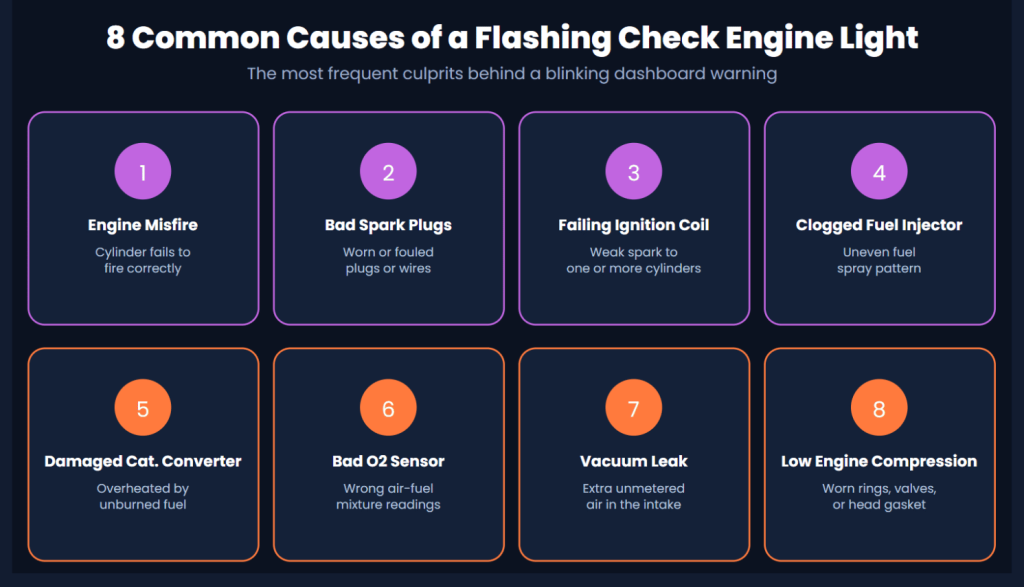
This is the root cause behind almost every case like this. A misfire happens when a cylinder doesn’t complete its combustion cycle properly — the spark doesn’t ignite the fuel-air mixture the way it’s supposed to. It can happen in just one cylinder or bounce around between several, and it’s often the symptom that triggers the light rather than the actual root cause itself.
2. Worn or Fouled Spark Plugs:
Spark plugs wear out over time, and when they do, they can’t create a strong enough spark to ignite fuel cleanly. Old, fouled, or improperly gapped plugs are one of the most common — and most affordable — reasons behind a blinking check engine light, especially in vehicles that are overdue for routine maintenance.
3. Failing Ignition Coil:
Modern vehicles typically use individual ignition coils for each cylinder (or coil packs), and when one starts to fail, that specific cylinder stops firing correctly. A bad ignition coil often causes a rough idle, a noticeable loss of power, and in many cases, it’s paired with a stored trouble code that points directly at the affected cylinder.
4. Clogged or Failing Fuel Injector:
Fuel injectors are responsible for delivering a precise amount of fuel into each cylinder at exactly the right time. When an injector gets clogged with debris or starts to fail electrically, the fuel spray pattern becomes uneven, which can easily cause a misfire and trigger that warning light.
5. Damaged Catalytic Converter:
Sometimes the catalytic converter isn’t the original cause of the problem — it’s the victim. When unburned fuel from a misfire reaches the converter, it can overheat and melt the internal honeycomb structure, turning a relatively cheap repair into one of the most expensive fixes on this entire list.
6. Faulty Oxygen Sensor:
Oxygen sensors measure how much unburned oxygen is in your exhaust and help the engine computer fine-tune the air-fuel mixture. A failing O2 sensor can send bad data to the computer, throwing off that mixture enough to cause a misfire, particularly in vehicles with higher mileage.
7. Vacuum Leaks:
Your engine relies on a very specific ratio of air to fuel, and a vacuum leak — often from a cracked hose, a bad gasket, or a loose intake connection — lets in extra, unmetered air. That throws off the mixture and can be enough to cause the kind of misfire that triggers this warning, especially at idle.
8. Low Engine Compression:
This is the one nobody wants to hear. Worn piston rings, valve issues, or a blown head gasket can all cause low compression in one or more cylinders, meaning that cylinder simply can’t build enough pressure to fire properly no matter how good the spark or fuel delivery is. This is typically the most serious and most expensive cause on this list, and it usually requires a proper diagnostic to confirm.
What a Blinking Check Engine Light Actually Means for Your Car Right Now?
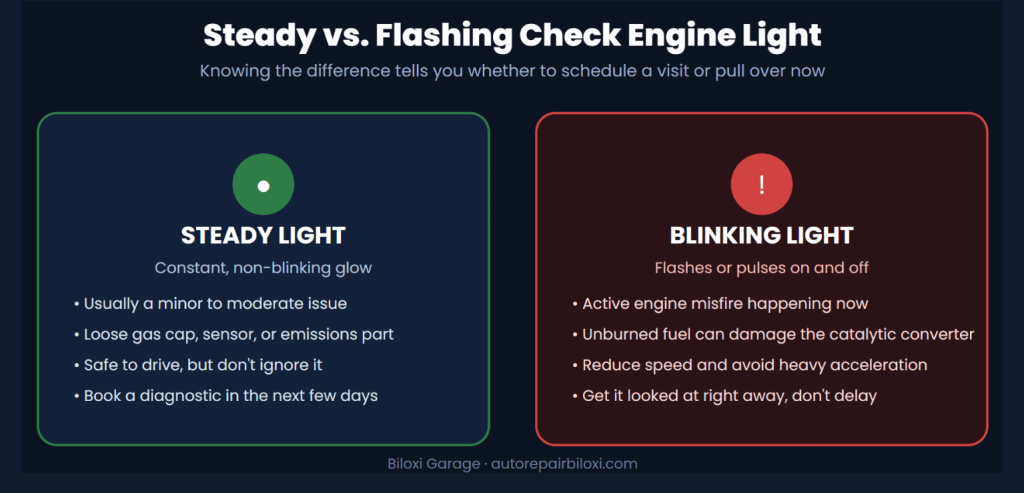
If you’re wondering what does the flashing engine light mean in practical terms, think of it less as a warning and more as an alarm. A steady check engine light is your car saying “something needs attention.” A blinking one is your car saying “something is actively happening that could hurt me if you keep driving like this.” The distinction matters because continuing to drive normally — accelerating hard, holding highway speeds, ignoring it for days — can push unburned fuel through your exhaust system fast enough to cook your catalytic converter, turning a repair that might have cost a few hundred dollars into one that costs well over a thousand.
What You Should Do the Moment It Starts Blinking?
If the light starts blinking while you’re driving, ease off the accelerator, avoid hard acceleration or towing, and get to a safe place to pull over as soon as you reasonably can. Pay attention to how the car feels — a rough idle, a noticeable loss of power, a burning smell, or popping sounds from the exhaust are all signs that you shouldn’t keep driving any further than necessary. Once you’re safely stopped, the smartest move is to get the car looked at rather than trying to guess your way through it, since a generic code reader will point you toward a system, but it takes an actual diagnostic to pin down the specific cause.
Is It Ever Okay to Keep Driving?
Technically, yes — you can usually limp a car with a blinking check engine light to a nearby shop if you drive gently and keep the distance short. But this isn’t the moment to run errands around Biloxi or push through a long commute. The longer a misfire continues, the more unburned fuel passes through your exhaust, and the more damage accumulates on your catalytic converter. If the car is shaking, losing power, or the smell of fuel is noticeable, it’s worth having it towed rather than risking a bigger repair bill down the road.
Get Your Check Engine Light Diagnosed at Biloxi Garage:
If you’re dealing with a check engine light Biloxi drivers are all too familiar with — especially the blinking kind — the team at Biloxi Garage is a solid place to start. They handle full engine diagnostics rather than just reading a generic code and guessing, which matters a lot when this kind of warning can be caused by anything from a $20 spark plug to a compression issue. Their technicians look for what’s actually causing the misfire — whether that’s ignition, fuel delivery, a sensor, or something deeper in the engine — before recommending any repair, so you’re not paying for parts you don’t need. Biloxi Garage handles everything from spark plug and ignition coil replacement to fuel system service, sensor diagnostics, and catalytic converter repair, all under one roof at their Pass Road shop. You can reach them at (228) 385-8455 to get your vehicle looked at before a manageable misfire turns into a much bigger repair.
When It’s More Than Just the Check Engine Light?
Sometimes this kind of dashboard warning shows up alongside other issues entirely unrelated to the misfire itself — a battery on its last leg, worn brakes, or an overdue oil change that’s been ignored for a while. Biloxi Garage handles general auto repair and maintenance beyond just engine diagnostics, so if your visit uncovers something else going on, it can typically be addressed in the same appointment instead of sending you to a second shop. And if you happen to be dealing with a small engine repair Biloxi project — a mower, generator, or other small equipment engine acting up — it’s worth asking the shop directly what they can take on, since small engine work isn’t handled the same way as full vehicle repair.
Frequently Asked Questions:
1. What’s the difference between a steady and a blinking check engine light?
A steady light usually points to a moderate issue you can schedule service for soon, while a blinking one signals an active engine misfire that needs attention right away.
2. Can I keep driving with the light blinking?
You can typically drive gently for a short distance to the nearest shop, but continuing to drive normally risks serious damage to your catalytic converter.
3. What does the flashing engine light mean if the car still feels fine?
Even if the car feels normal, a blinking light means a misfire is happening internally, and the lack of obvious symptoms doesn’t mean it’s safe to ignore.
4. Is a blinking check engine light an emergency?
It’s not usually a “call 911” emergency, but it is an urgent mechanical issue that should be looked at the same day if possible.
5. How much does it cost to fix this kind of issue?
Costs vary widely depending on the cause — spark plugs might run under $200, while a damaged catalytic converter or compression issue can run well over $1,000.
6. Can a loose gas cap cause the check engine light to blink?
No, a loose gas cap typically causes a steady light related to the evaporative emissions system, not a blinking one.
7. Will an auto parts store code reader tell me exactly what’s wrong?
A code reader will point you toward a general system or cylinder, but it won’t tell you the specific root cause — that requires a full diagnostic from a mechanic.
8. What does a blinking check engine light usually mean in older vehicles?
In older, higher-mileage vehicles, a blinking check engine light is often tied to worn spark plugs, ignition components, or declining compression rather than a single simple fix.
9. Can bad gas cause this kind of blinking?
Yes, poor-quality or contaminated fuel can cause a misfire severe enough to trigger the light, especially in vehicles already due for maintenance.
10. How quickly can a blinking light damage my catalytic converter?
Catalytic converter damage from unburned fuel can start occurring within minutes of continuous driving with an active misfire.
11. Should I turn off my car if the check engine light starts blinking?
If you notice shaking, loss of power, or unusual smells, it’s safest to pull over and shut the engine off rather than continuing to drive.
12. Does a blinking check engine light mean my car will break down?
Not necessarily right away, but ignoring it increases the risk of a breakdown or a much larger repair bill over time.
13. Can a mechanic tell what’s wrong just from the code?
The trouble code narrows things down, but an experienced technician still needs to inspect ignition components, fuel delivery, and compression to confirm the exact cause.
14. Is it normal for the check engine light to blink intermittently?
Yes, some misfires are intermittent, which can cause the light to blink, then go steady, or even turn off temporarily — but the underlying issue is still there.
15. What’s the most expensive cause of this kind of misfire?
Low engine compression from worn internal components or a blown head gasket is typically the most expensive issue on this list to repair.
16. Can I ignore a blinking check engine light if it goes away on its own?
No, even if the light turns off, the underlying misfire issue is still present and should be diagnosed rather than assumed resolved.
17. Does towing damage my car more than driving with the light blinking?
No, towing is generally the safer option since it avoids putting additional strain on the engine and exhaust system.
18. How often should I replace spark plugs to avoid this issue?
Most vehicles need spark plug replacement somewhere between 30,000 and 100,000 miles depending on the plug type, so check your owner’s manual for the specific interval.
19. Can weather affect a blinking check engine light?
Cold starts and humid conditions can sometimes worsen an existing misfire or ignition issue, making the light more likely to appear or blink.
20. Where can I get this checked in Biloxi?
Biloxi Garage offers full engine diagnostics and repair for this kind of issue, along with general auto maintenance, at their Pass Road location in Biloxi, MS.